
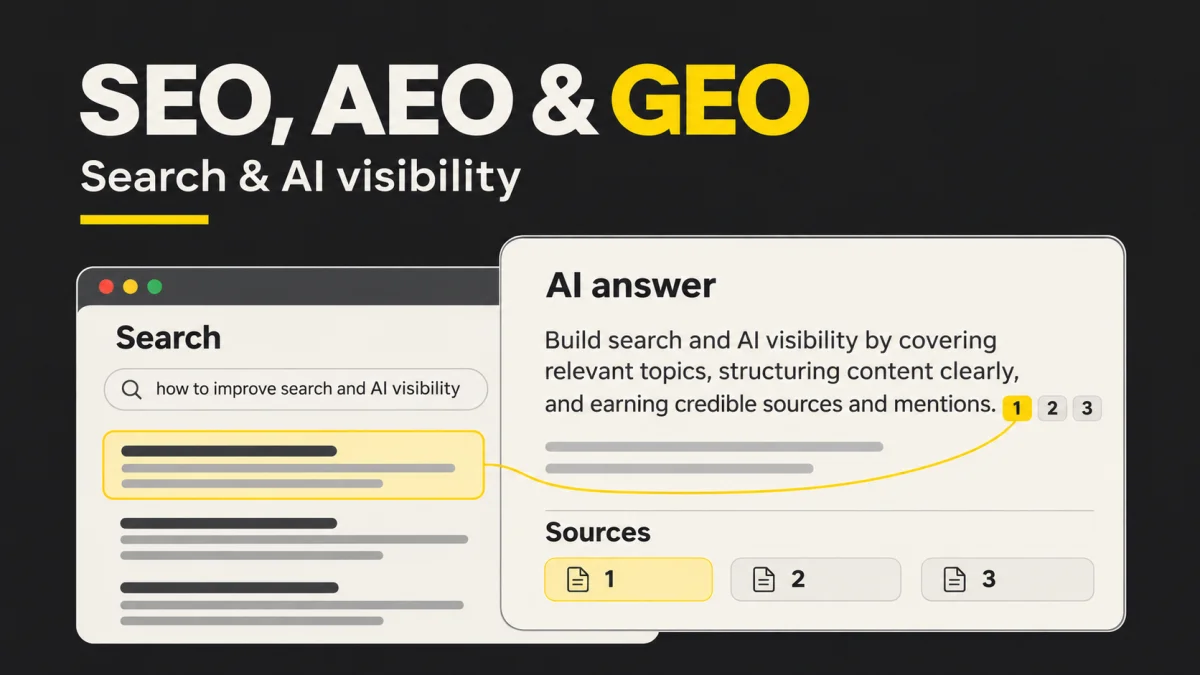
SEO helps people find your website through search. AEO makes your content useful as a direct answer. GEO is a working term for making your business understandable in generative search experiences. For a business in Indonesia, start with accessible pages, clear service information, and evidence that a prospective customer can verify.
I treat discoverability as part of building a product. A page should help someone decide what to do next and give search systems a clear account of the same facts.
How SEO, AEO and GEO differ
The table below describes practical editorial goals. AEO and GEO are industry shorthand; they are not separate certification programs or a promise of placement.
| Approach | Main question | Useful work | What to observe |
|---|---|---|---|
| SEO: search engine optimization | Can a relevant customer discover this page? | Descriptive titles, crawlable links, useful service pages | Indexed pages, relevant search visits, qualified enquiries |
| AEO: answer engine optimization | Does this page answer a specific question clearly? | Direct introductions, comparison tables, concrete FAQs | Whether readers find the answer and reach the next step |
| GEO: generative engine optimization | Can a generative system understand and attribute our information? | Consistent identity, explicit scope, evidence and sources | Relevant citations observed over time, with their context |
Google says its established SEO practices remain relevant to AI Overviews and AI Mode; there is no special schema or AI file required for those features. That guidance is specific to Google, rather than a guarantee about every AI product. See Google’s guidance on AI features.
Start with the customer’s decision
Imagine a Surabaya operations team looking for someone to replace a spreadsheet-based approval process. Before choosing a framework or writing a blog post, list the questions that team needs answered:
- Which workflow can the software support?
- Who will use it, and who can approve sensitive changes?
- What happens to existing records?
- How will the team verify that the first release works?
- Who maintains it after handover?
A useful service page answers these questions in plain language. It can link to a relevant project, explain the engineer’s role, and offer a straightforward way to discuss the workflow. Repeating “software engineer Indonesia” in every paragraph adds little decision value.
Make location meaningful
If you serve clients in Surabaya or Jakarta, describe the working arrangement accurately: remote collaboration, meeting availability, language, and handover process. A city page should contain something useful about that service relationship. Publishing near-identical city pages without operational detail makes the website harder to maintain and gives visitors little reason to read each one.
Use a consistent person or company name across the introduction, project descriptions, author information, and contact page. State what a project actually demonstrates. An internal government application can still be a useful case study when its public description explains the problem, responsibilities, and access limitations without exposing confidential data.
Build an answer people can verify
A practical article can begin with a two-sentence answer, then explain the assumptions. A comparison page can name the decision criteria before discussing the options. A case study can distinguish what was built from what was measured.
When describing an AI feature, include its source material, review process, and failure handling. “Answers questions using approved service documents” tells a buyer more than “revolutionary AI solution.” If a numerical outcome is unavailable, explain the delivered capability and how a customer could evaluate it. Do not invent a performance result to complete a marketing template.
Structured data can describe visible information in a machine-readable form. Keep the identity, dates, and article details aligned with the page; adding markup does not guarantee a rich result. See Google’s structured data introduction.
A manageable first release
For a small professional website, I would prioritize a clear profile, a service explanation, a few substantive project pages, a contact route, and articles addressing real buying questions. Before launch, open each URL directly, check its title and language, follow its links, and complete the contact journey on a phone.
After launch, review the actual enquiries alongside search visibility. Record which page helped a prospect, what remained unclear, and whether the project fit the service. Treat an AI citation as an observation with a date and query, rather than evidence that an optimization method always works.
Frequently asked questions
Should an Indonesian business prioritize SEO, AEO or GEO?
Start with a useful, accessible website and a coherent description of your service. Add direct answers and verifiable case studies as part of that work. This gives the team a maintainable foundation across discovery channels.
Can anyone guarantee first place or an AI recommendation?
No. A responsible proposal specifies the work, the acceptance checks, and how results will be evaluated. Google also explains that there is no automatic route to first place in its SEO Starter Guide.
Do I need both English and Indonesian?
Use the languages your customers need, and budget for maintaining both. A complete Indonesian service page is more useful than an English page with only translated navigation. Read the bilingual website SEO guide for a practical publishing workflow.
Where can I see the engineering behind this approach?
Explore my software portfolio for government, enterprise, and SaaS projects. If you are planning a website or business application in Indonesia, contact me with the users, workflow, and constraints you want to address.